
Buying hardware for a new door sounds simple until you actually start doing it.
First you need handles.
Then an aldrop.
Then hinges.
Then a latch.
Then a tower bolt.
Then a door stopper.
And after buying everything separately, you may realise that the finishes don’t match, one fitting is the wrong size, or you’ve simply forgotten an important component.
That’s exactly where a door kit becomes useful.
Instead of selecting every door accessory separately, a door kit combines commonly required hardware into one coordinated set.
For homeowners renovating a house, installing new wooden doors or replacing old fittings, the right door kit for home can save time while giving the door a cleaner and more consistent appearance.
But not every door kit contains the same items, and a kit designed for a bathroom door may not be appropriate for your main entrance.
This guide explains what a door kit contains, the different types available, which materials to consider and what you should check before buying one in India.
What Is a Door Kit?
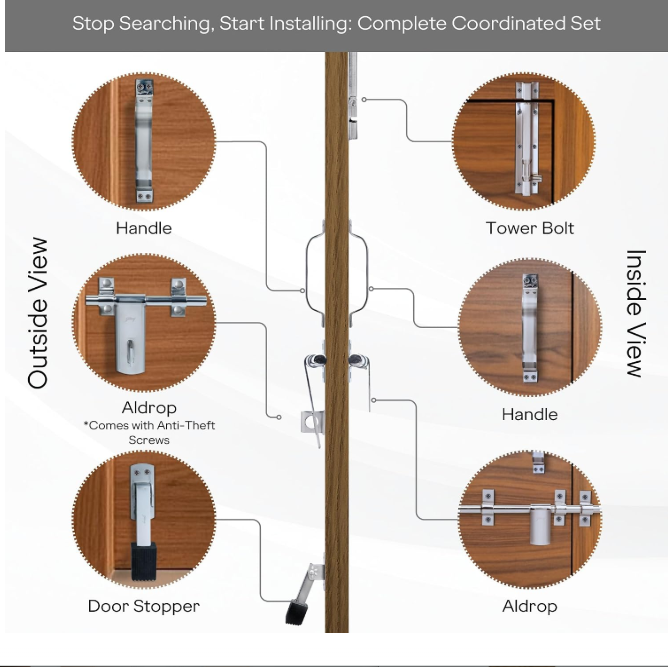
A door kit is a combination of door hardware accessories sold together as a set.
Depending on the kit, it may contain:
- Door handles
- Aldrop
- Door latch
- Tower bolt
- Door stopper
- Hinges
- Screws and fitting hardware
- Lock or locking accessories
Some larger main door kits may contain additional fittings, while simpler kits may include only the essential accessories.
The main advantage is convenience.
Instead of buying multiple individual items and trying to match their colour, material and design, you get a coordinated hardware set for one door.
What Does a Door Kit Include?
This is one of the most important things to check before buying because there is no universal list of components included in every door kit.
Let’s look at the common items individually.
Door Handles
Handles are usually the most visible part of a door kit.
A typical set may include two handles — one for each side of the door.
Since you’ll touch the handles several times every day, check their material, grip, mounting quality and finish rather than choosing them only by appearance.
Aldrop
An aldrop is a traditional sliding door-fastening accessory widely used on Indian doors.
It is particularly common on main doors, double doors and entrance doors.
Door kits are available with aldrops in different sizes, materials and designs.
If you’re buying a kit specifically for your main entrance, check that the aldrop size is appropriate for the width and construction of your door.
Door Latch
A latch provides a simple way to secure a door from one side.
It may be useful as an additional fastening mechanism depending on your door setup.
The latch should operate smoothly and should not feel loose after installation.
Tower Bolt
A tower bolt slides into a receiver to hold the door securely in position.
Tower bolts are especially useful on double doors, secondary shutters and doors where an additional internal fastening point is required.
Some door kits include one tower bolt while others may contain more than one.
Door Stopper
A door stopper prevents the door from swinging too far and hitting a wall, furniture or another surface.
It’s a small accessory, but forgetting it during a new installation is surprisingly common.
Buying a complete door accessories kit can ensure that smaller fittings like this aren’t overlooked.
Hinges
Certain door kits also include hinges.
Hinges carry the weight of the door and allow it to open and close, which makes their quality extremely important.
If hinges are included, check their size, thickness, material and load suitability for your door.
Don’t assume that a hinge is suitable merely because it came inside the kit.
Why Should You Buy a Door Kit Instead of Individual Accessories?
Buying everything separately gives you maximum freedom.
But it also creates more opportunities for mismatched hardware.
A door kit offers several practical advantages.
1. Matching Design
Buying a door fitting kit makes it easier to maintain a consistent appearance.
The handle, aldrop, latch and other fittings can share the same finish and design language.
This looks much cleaner than combining random hardware pieces bought at different times.
2. Easier Shopping
Imagine furnishing ten doors in a new home.
Buying every handle, latch, stopper, tower bolt and hinge individually can quickly become complicated.
A complete kit simplifies the purchase.
Instead of remembering six or seven different hardware pieces for every door, you can select the correct kit for each door type.
3. Better Budget Planning
A kit gives you a clearer idea of what you’re spending on hardware for each door.
That can be particularly useful while building or renovating a house where hardware costs across multiple rooms can add up quickly.
4. Fewer Missing Accessories
It is easy to remember the handle.
It is equally easy to forget the stopper.
A well-chosen kit reduces the chance of discovering during installation that one small but necessary accessory hasn’t been purchased.
5. Consistent Finish
Imagine a black door handle, chrome latch and gold-toned tower bolt on the same door.
Each item may look fine individually, but together they can make the door appear poorly planned.
A matching door kit helps maintain visual consistency.
Types of Door Kits Available for Homes
Different doors have different requirements.
This is why you shouldn’t simply search for the cheapest door kit and install the same set everywhere.
Main Door Kit
A door kit for main door is generally designed for the entrance of a house or apartment.
Depending on the configuration, it can contain:
- Larger handles
- Aldrop
- Latch
- Tower bolt
- Door stopper
- Hinges
- Other matching accessories
Since the main door receives frequent use and contributes significantly to the appearance of your entrance, durability and finish quality matter more here.
If security is the priority, remember that a hardware kit should complement your main locking system rather than replace an appropriate main-door lock.
Single Door Kit
A single door kit is designed for one standard door and typically combines commonly required fittings.
These sets can be useful for bedrooms, entrances and other residential doors depending on the exact contents.
Always check the product listing because “single door kit” describes the application, not a fixed list of included components.
Double Door Kit
Double doors often require additional fastening hardware.
One door leaf may remain fixed for much of the time while the other operates normally.
As a result, a double-door kit may require additional tower bolts, aldrops or other fittings compared with a standard single-door set.
Bathroom Door Kit
A bathroom door kit generally prioritises functionality and corrosion resistance.
Depending on the design, it can contain handles, latch, hinges and other basic bathroom-door accessories.
Bathrooms are exposed to higher humidity, so material and finish quality should receive extra attention.
Bedroom Door Kit
Bedroom doors generally don’t need the same heavy hardware arrangement as a main entrance.
A simpler door kit with comfortable handles, suitable hinges and privacy-related hardware may be enough.
This is a good area to save money rather than installing oversized main-door fittings throughout the house.
Door Kit vs Mortise Lock Set: What’s the Difference?
These two products can easily be confused.
A door kit generally refers to a broader collection of door fittings such as handles, aldrop, latch, tower bolt, hinges and stopper.
A mortise lock set is primarily a locking system and typically revolves around:
- Mortise lock body
- Handle
- Cylinder
- Keys
- Strike plate
- Related fitting hardware
So which one do you need?
Sometimes, both.
For example, your main door could have a mortise lock for primary locking while also using matching door accessories from a larger hardware kit.
Think of it this way:
Door kit = overall door fittings
Mortise lock set = primary locking hardware
Choose according to the actual door setup rather than assuming one completely replaces the other.
Stainless Steel Door Kit: Is It a Good Choice?
A stainless steel door kit is one of the common options available for Indian homes.
Stainless steel is often chosen for door hardware because it can provide a clean appearance, useful durability and corrosion resistance when an appropriate grade and finish are used.
However, don’t buy something solely because the product title says “stainless steel.”
Look at:
- Material specification
- Thickness
- Weight
- Surface finish
- Construction
- Warranty
- User application
- Quality of moving parts
Two products described as stainless steel can still differ considerably in construction and durability.
Which Finish Should You Choose for Your Door Kit?
Door hardware now comes in far more finishes than traditional silver.
Popular design options can include:
- Satin steel
- Chrome
- Matte black
- Black and gold
- PVD gold
- Antique brass
- Rose gold
- Bronze-style finishes
- Dual-tone finishes
Choose according to the colour of your door and surrounding interior.
For example, a matte black kit can work well with light wooden doors and contemporary interiors.
Gold or antique finishes can complement more decorative or traditional main doors.
Chrome and satin finishes provide a cleaner and more neutral look.
But appearance should come after material and construction.
A beautiful finish won’t help if the handle becomes loose or the latch stops operating smoothly.
10 Things to Check Before Buying a Door Kit
1. Decide Which Door You’re Buying For
Start by identifying the application.
Is the kit for:
- Main door
- Bedroom
- Bathroom
- Balcony
- Kitchen
- Office
- Double door
The correct hardware depends on where the door is being used.
2. Check What’s Actually Included
Never assume that “complete door kit” means everything you need.
Read the included-components list carefully.
For example, one kit may contain:
2 handles + aldrop + latch + tower bolt + stopper
while another may include hinges as well.
Compare the contents before comparing prices.
3. Check Every Component’s Size
The kit may fit your budget but still be wrong for your door.
Look at the dimensions of:
- Handles
- Aldrop
- Latch
- Tower bolt
- Hinges
- Stopper
Larger isn’t automatically better.
Choose dimensions appropriate for the door.
4. Check the Material
Don’t evaluate only the visible handle.
Check the materials used throughout the kit.
The aldrop, hinges and tower bolts receive mechanical stress too.
A good-looking handle combined with weak secondary fittings doesn’t make a good door kit.
5. Consider Door Weight
This is especially important if the kit includes hinges.
A heavy solid-wood main door requires different hinge support from a lightweight internal door.
Ask your carpenter or installer whether the included hinges are appropriate for your door’s size and weight.
6. Check Corrosion Resistance
This matters especially for:
- Bathrooms
- Balconies
- Coastal areas
- Exterior-facing doors
- Humid environments
Select materials and finishes suited to the environment in which they’ll actually be used.
7. Check the Finish Carefully
Product photographs can make finishes look different from how they appear under normal room lighting.
If matching the hardware to your interior is important, check accurate product images and finish descriptions before purchasing.
8. Don’t Ignore Screw Quality
A hardware set depends on the way it is fixed to the door.
Appropriate screws and proper installation affect how securely handles, hinges and other components remain attached.
Your installer may recommend different fixing hardware depending on the door construction.
9. Check Warranty and Brand Support
Door hardware is used every day.
Warranty and replacement support can become important if a handle, latch or other moving component develops a problem.
Consider after-sales availability instead of making a decision purely on discount percentage.
10. Plan Installation Before Buying
Speak to the carpenter or installer before ordering hardware for expensive or customised doors.
Knowing the door dimensions, material and intended fitting arrangement beforehand can prevent unnecessary drilling or modification later.
Door Kit for Main Door: What Should You Prioritise?
The main entrance deserves more attention than an internal room door.
Here’s a useful buying order.
Step 1: Determine the door dimensions and material.
Step 2: Decide which accessories are actually required.
Step 3: Select your main locking system.
Step 4: Choose suitable handles.
Step 5: Select an aldrop and additional fastening hardware if required.
Step 6: Confirm the hinges can support the door.
Step 7: Select the finish.
Step 8: Check installation requirements.
Step 9: Compare complete kits.
Step 10: Check warranty and support.
Notice that colour comes relatively late in the process.
That’s intentional.
Function first.
Appearance second.
Door Kit for New Home vs Door Kit for Renovation
Your buying strategy may change depending on whether you’re working on a new house or upgrading existing doors.
For a New Home
You have greater freedom.
The door can be planned around the hardware, and your carpenter can prepare it according to the chosen fittings.
You can also buy matching kits for several rooms to maintain consistent hardware throughout the house.
For Renovation
Measurements become much more important.
Existing screw holes, handle positions and marks left by old fittings can affect which replacements will look good.
Before buying a new kit, measure your existing hardware and photograph the door.
A slightly larger replacement fitting can sometimes cover old marks, but this should be planned rather than assumed.
Should Every Door in Your House Have the Same Door Kit?
Not necessarily.
Consistency is good, but identical hardware isn’t always practical.
A better strategy is to maintain the same design family or finish while selecting different functional hardware for different rooms.
For example:
Main door: Heavy-duty hardware + main locking system
Bedrooms: Matching handles + simpler privacy hardware
Bathrooms: Moisture-resistant fittings
Balcony: Hardware selected for environmental exposure
This gives your house a consistent appearance without spending unnecessarily on heavy main-door hardware for every room.
Door Kit Price in India
There isn’t one fixed door kit price in India.
Cost depends on several factors:
- Number of components
- Material
- Handle size
- Aldrop size
- Number and size of hinges
- Finish
- Manufacturing quality
- Brand
- Warranty
- Decorative design
Basic bathroom or internal-door kits can cost much less than larger decorative main-door fitting sets.
When comparing prices, compare what is actually inside the box.
A ₹1,000 kit containing four components isn’t necessarily a better deal than a ₹1,500 kit containing seven useful fittings.
Use this comparison:
Total price ÷ useful components + quality + suitability
rather than simply choosing the biggest discount.
Common Mistakes When Buying Door Hardware Kits
Buying Only for Looks
That black-and-gold kit may look amazing online.
But first confirm whether its dimensions and components suit your door.
Assuming Every Kit Contains a Lock
Many door kits contain accessories but not a primary door lock.
Check separately whether you need a mortise lock, deadbolt, rim lock or smart lock.
Buying the Same Kit for Every Door
A bathroom door and a main entrance perform very different jobs.
Their hardware should reflect that.
Ignoring Hinge Capacity
If hinges are included, verify that they’re appropriate for the weight of your door.
Choosing Oversized Hardware
A huge aldrop or handle on a relatively narrow door can look awkward.
Match the proportions to the door.
Mixing Finishes Later
If you buy an incomplete kit and add accessories later, try to match not just the colour but the finish.
“Gold,” “brass,” “antique brass” and “PVD gold” can look very different.
How to Maintain a Door Kit
Good door hardware doesn’t require complicated maintenance.
Clean the fittings regularly with a suitable soft cloth.
Avoid harsh chemicals unless the manufacturer specifically recommends them, because some cleaners can damage decorative finishes.
Check loose screws periodically.
Don’t force a latch or tower bolt that has become misaligned.
If a door starts sagging, fix the alignment problem rather than forcing the hardware every day.
For hinges or moving parts, follow the manufacturer’s lubrication recommendations.
Properly installed and maintained hardware generally provides much better long-term performance than fittings that are repeatedly forced when the door is out of alignment.
Is It Better to Buy a Complete Door Kit?
For many homeowners, yes.
A complete door hardware kit is particularly useful when:
- You’re installing new doors
- You’re renovating several rooms
- You want matching finishes
- You don’t want to select every fitting individually
- You need predictable hardware costs
- You want a coordinated appearance
Buying separately can still be better if you want a highly customised combination or already have some of the necessary hardware.
The right approach depends on the project.
Frequently Asked Questions About Door Kits
What is included in a door kit?
The contents vary between products. A door kit may include handles, aldrop, latch, tower bolt, door stopper, hinges and fitting accessories. Always check the exact product contents before purchasing.
Which door kit is best for a main door?
The best kit depends on your door material, dimensions, weight, required fittings and preferred finish. Main doors generally benefit from more substantial hardware than internal room doors.
Does a door kit include a lock?
Not always. Many door kits contain general door accessories but don’t include the primary locking system. Read the product specifications carefully.
Can I use a door kit on a wooden door?
Many door kits are intended for wooden doors, but compatibility depends on the fitting dimensions, door thickness, weight and installation method.
What is the difference between a door kit and a door lock set?
A door kit generally contains multiple door accessories such as handles, aldrop, latch and stopper. A door lock set focuses mainly on the locking mechanism and related components.
Is a stainless steel door kit good?
Stainless steel can be a practical door-hardware material because of its durability and corrosion resistance, but actual quality depends on the grade, thickness, construction and finish of the product.
Which door kit is best for a bathroom?
Look for a kit suited to bathroom use with appropriate corrosion resistance, manageable hardware sizes and the privacy fittings your bathroom requires.
Can I install a door kit myself?
Simple accessories can sometimes be fitted by experienced DIY users, but accurate alignment and secure fixing are important. For new or expensive doors, professional installation is usually preferable.
How do I select door-kit size?
Measure the door dimensions and check the individual sizes of the handles, aldrop, latch, hinges and other components. Your carpenter or installer can help confirm the correct proportions.
Is buying a complete door kit cheaper?
It can be more convenient and may offer good overall value, but don’t assume a kit is automatically cheaper. Compare the quality and usefulness of the included components against buying them individually.
Final Thoughts: Is a Door Kit Worth Buying?
A door kit makes one of the more frustrating parts of choosing door hardware much simpler.
Instead of searching separately for a handle, aldrop, latch, tower bolt, hinges and stopper, you can buy a coordinated collection of fittings designed to work visually together.
But the word “kit” doesn’t automatically mean the product contains everything your door needs.
Before buying, check:
Door type
Door size and weight
Included components
Hardware dimensions
Material
Finish
Hinge suitability
Primary locking requirements
Installation
Warranty
For your main entrance, prioritise construction and suitability before appearance.
For bedrooms and bathrooms, you can choose simpler hardware according to the room’s requirements.
A well-selected door kit for home can give your doors a more coordinated finish, simplify installation and reduce the hassle of purchasing every fitting separately.
Planning new doors or renovating your home? Explore our range of door kits, door handles, mortise locks and matching door hardware to find the right combination for every room.
Not sure which kit you need?
Share your door size, door type and preferred finish with us, and we’ll help you select a suitable door hardware kit.