
Your front door is the first layer of security between your family and the outside world. Yet many Indian homes still depend on the same type of lock and key that has been used for decades.
Keys can be misplaced. Duplicate keys can be made. You may leave home and suddenly wonder, “Did I lock the door?”
A smart door lock solves many of these everyday problems while adding a more convenient way to control access to your home.
Instead of depending only on a physical key, modern smart locks can let you open your door using your fingerprint, PIN, RFID card, smartphone or temporary access code.
But with so many options available, choosing the best smart door lock for your home in India can get confusing.
Should you buy a fingerprint lock or WiFi lock? Do you really need a camera? What happens when the battery runs out? And most importantly, how do you know whether a smart lock will actually fit your door?
This guide answers those questions before you spend your money.
What Is a Smart Door Lock?
A smart door lock is an electronic locking system that provides one or more keyless ways to unlock a door.
Depending on the model, a smart lock may support:
- Fingerprint unlocking
- PIN or password access
- RFID cards
- Mobile app control
- WiFi or Bluetooth connectivity
- Temporary OTP access
- Mechanical emergency keys
- Face recognition
- Built-in cameras and doorbells
Think of it as combining the physical security of a door lock with the convenience of modern technology.
For everyday use, the biggest difference is simple: you don’t have to search for your keys every time you reach the door.
Why Are Smart Door Locks Becoming Popular in Indian Homes?
Smart locks used to feel like something meant only for luxury apartments.
That is changing.
Today, there are smart locks available across different price ranges, and homeowners are becoming more comfortable with fingerprint sensors, mobile apps and digital access systems.
The convenience becomes particularly noticeable in a busy household.
Imagine returning home carrying grocery bags. Instead of searching through your pockets for a key, you place your finger on the sensor and open the door.
Or imagine your house help arrives while you’re away. Rather than leaving a spare key with someone, compatible smart locks can allow you to create temporary or time-limited access.
These are small conveniences, but when you use your main door several times every day, they quickly become useful.
7 Benefits of Installing a Smart Door Lock for Home
1. No More Searching for Keys
This is probably the benefit you’ll notice first.
With a fingerprint door lock, your fingerprint effectively becomes your key.
Depending on the lock, other family members can also register their fingerprints or receive their own PIN.
It means fewer situations where someone is standing outside because they forgot their key.
2. Multiple Ways to Unlock Your Door
A good digital lock doesn’t force you to rely on only one access method.
Many models provide a combination of fingerprint, PIN, RFID, app access and mechanical backup.
That redundancy is important.
If your finger is wet and the fingerprint reader doesn’t recognise it, you may still be able to enter using a PIN or another available method.
When comparing smart locks, multiple reliable access methods are usually more useful than one flashy feature.
3. Temporary Access for Guests and Staff
Indian households often need to provide access to house help, relatives, cleaners, drivers or other visitors.
Giving everyone a physical key isn’t always practical.
Certain WiFi or app-connected smart locks allow homeowners to create temporary PINs or OTP-based access.
Instead of handing over a permanent key, you can provide access when it is actually needed.
4. Automatic Locking
We’ve all experienced that moment after leaving home:
“Did I lock the door?”
Smart locks with auto-lock functionality can automatically lock the door after it closes.
The exact behaviour varies between models, so check how the feature works before buying.
Still, for people who regularly forget to lock the door, this can be one of the most practical smart-lock features.
5. Access Records
Compatible smart locks can maintain entry records through their apps.
Depending on the product, this can help you see when registered users or access methods were used.
For families, rental properties and homes with regular staff movement, this can provide an additional level of visibility that a conventional lock cannot offer.
6. Modern Appearance
Security hardware doesn’t necessarily have to look industrial.
Today’s digital door locks are available in sleek designs and finishes that can complement modern wooden doors and apartment interiors.
A well-chosen smart lock can therefore improve both functionality and the appearance of your entrance.
7. Remote Features
If remote access matters to you, look specifically for a WiFi smart door lock or a compatible gateway-based system.
Depending on the model and setup, connected locks may provide features such as remote access management, notifications, temporary passwords and app-based controls.
Don’t assume every smart lock has remote unlocking simply because it has an app. Bluetooth-only and WiFi-enabled locks can behave very differently.
Smart Door Lock vs Traditional Door Lock
A traditional lock is simple, familiar and usually less expensive.
A smart lock adds convenience and access-management features.
| Feature | Traditional Lock | Smart Door Lock |
|---|---|---|
| Physical key | Yes | Usually optional/backup |
| Fingerprint access | No | Available |
| PIN access | No | Available |
| RFID access | No | Available on many models |
| Smartphone access | No | Available on compatible models |
| Temporary access | No | Available on compatible models |
| Entry records | No | Available on some models |
| Auto-lock | No | Available |
| Initial cost | Lower | Higher |
A smart lock isn’t automatically the correct choice for every home.
If you simply want an inexpensive mechanical lock with no electronics, a quality traditional lock can still make sense.
But if convenience, keyless entry and controlled access matter to your household, a smart lock for home becomes much more attractive.
Which Type of Smart Door Lock Should You Buy?
This is where buyers often get distracted by long feature lists.
Start with how you actually plan to use the lock.
Fingerprint Door Lock
A fingerprint door lock is a good option for families who want quick everyday access without carrying keys.
Place your registered finger on the sensor, wait for authentication and open the door.
When buying one, look beyond the number of fingerprints advertised. Pay attention to sensor reliability and make sure there are alternative unlocking methods.
PIN or Password Door Lock
A PIN lock allows you to enter a numeric password.
This can be useful for family members who don’t want to use fingerprints.
Choose a lock that provides appropriate security features around PIN entry, and avoid using obvious codes such as birthdays or simple sequences.
RFID Smart Lock
RFID cards or tags provide another easy access option.
They can be particularly convenient for older family members who prefer something physical but don’t want to operate a mobile app.
WiFi Smart Door Lock
A WiFi smart lock is worth considering if remote functionality is one of your priorities.
Depending on the model, it can offer remote management, notifications or guest-access features.
If you’ll never use those capabilities, paying extra solely for WiFi may not provide much value.
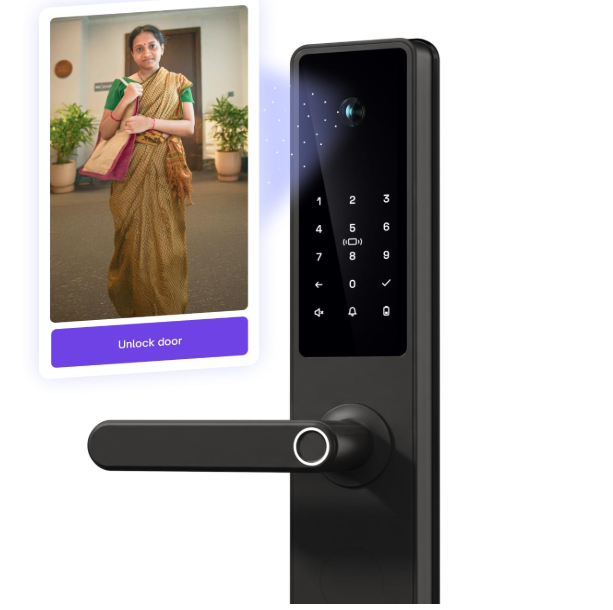
Smart Lock With Camera
Some premium smart locks combine the door lock with a camera and, in certain cases, a doorbell.
This lets you combine access control with visitor monitoring.
It can be useful if you’re already planning to buy both a digital lock and a video-door solution, but don’t choose a camera lock just because it sounds more advanced.
First evaluate the quality of the actual lock.
10 Things to Check Before Buying a Smart Door Lock in India
This section may save you from making an expensive mistake.
1. Check Your Door Type First
Do this before comparing features.
Is your main door:
- Wooden?
- Metal?
- Glass?
- Aluminium?
- A single door?
- A double door?
A smart lock isn’t universally compatible with every door.
A beautiful ₹20,000 lock is useless if it cannot be properly installed on your existing door.
2. Measure Door Thickness
Smart locks generally specify a supported range of door thicknesses.
Measure your door accurately before ordering.
If you’re unsure, ask the seller or installer to confirm compatibility rather than guessing.
3. Check the Existing Lock and Mortise
Replacing an existing lock can require changes to the door.
Ask whether the new smart lock is compatible with your existing setup and whether additional cutting or drilling will be required.
Professional installation is especially important for main-door locks.
4. Look for Multiple Unlocking Methods
For most homeowners, a practical combination might include:
Fingerprint + PIN + app/RFID + emergency key
You don’t necessarily need every unlocking technology available.
You do need reliable alternatives if your preferred method isn’t available.
5. Understand Battery Backup
Smart door locks generally run on batteries, so battery management matters.
Look for:
- Low-battery warnings
- Emergency power options
- Backup unlocking methods
- Clear battery-replacement instructions
Don’t wait until the battery is completely exhausted before replacing or charging it.
6. Check Emergency Access
Electronics can fail.
A responsible smart-lock purchase should therefore answer one simple question:
How do I enter my house if the electronic system isn’t working?
Depending on the model, emergency options can include a mechanical key or an external emergency-power connection.
Know the backup process before installation.
7. Look at Build Quality, Not Just Technology
A smart lock is still a lock.
Fingerprint speed and mobile apps are useful, but the physical hardware matters just as much.
Check the lock body, bolts, mortise, handle construction and overall build quality.
Don’t let an impressive app distract you from the mechanical part protecting the door.
8. Consider After-Sales Service
This is especially important in India.
A normal electronic gadget can be sent to a service centre.
Your main-door lock is different.
If something goes wrong, you need support quickly.
Before buying, check installation availability, warranty conditions and whether service is available in your city.
9. Check App and Connectivity Requirements
If you’re purchasing the lock for smartphone functionality, understand exactly what the app can do.
Ask whether the feature requires:
- Bluetooth
- Direct WiFi
- A separate gateway
- Internet access
- A specific mobile application
Also check what happens to basic unlocking functions when your internet connection is unavailable.
10. Don’t Buy Based Only on the Number of Features
A product described as an “8-in-1” lock isn’t automatically better than a well-built 4-in-1 lock.
Ask yourself which features you’ll genuinely use.
For many households, reliable fingerprint access, PIN access, backup access, auto-lock and good installation support are more valuable than a huge feature list.
Are Smart Door Locks Safe?
This is one of the first questions homeowners ask.
The better question is:
How secure is the specific smart lock you’re considering?
Smart locks add convenient authentication and access-management options, but they’re still security products. Build quality, installation, software, authentication design and backup mechanisms all matter.
Look for features such as tamper alerts, secure PIN functionality, strong physical construction and dependable backup access.
For connected models, buy from a manufacturer that clearly explains its app, warranty, software support and privacy practices.
And remember: even the best lock performs poorly if it is installed incorrectly.
What Happens If the Smart Lock Battery Dies?
This sounds scary until you understand how a good lock handles it.
Quality smart locks generally warn users before their batteries are fully depleted.
Depending on the model, there may also be an emergency-power option or mechanical backup key.
The exact process varies from lock to lock.
That’s why battery backup and emergency access should be checked before buying, not after you’re standing outside a locked door.
Is a WiFi Smart Lock Better Than a Normal Fingerprint Lock?
Not necessarily.
Choose based on your requirements.
If you mainly want to unlock your door quickly when you come home, a reliable fingerprint smart lock may be enough.
If you frequently need to manage access while away from home, a WiFi-enabled model may be more suitable.
Don’t pay for connectivity simply because it sounds more advanced.
Pay for features you’ll actually use.
Who Should Consider Buying a Smart Door Lock?
A smart door lock can be particularly useful for:
Families: Multiple members can have their own access method without carrying duplicate keys.
Working professionals: Keyless access and auto-lock features can make everyday entry and exit easier.
Homes with elderly family members: RFID, fingerprint or PIN access can reduce dependence on physical keys, depending on what the user finds easiest.
Homes with regular staff: Temporary or controlled credentials can reduce the need to distribute permanent keys.
Rental-property owners: Compatible connected locks can make controlled guest access easier.
People building smart homes: A connected lock can become another component of a broader home-automation setup.
How Much Does a Smart Door Lock Cost in India?
There isn’t one fixed smart door lock price in India.
The price varies according to the locking mechanism, materials, number of access methods, connectivity, brand, camera, installation and warranty.
Basic digital or fingerprint models occupy the lower end of the market, while locks with WiFi connectivity, premium hardware, cameras or advanced biometric systems cost more.
Rather than choosing the cheapest model, compare the total value:
Lock quality + useful features + installation + warranty + after-sales support.
Saving a little money upfront isn’t worthwhile if you end up with a lock that doesn’t fit properly or has poor service support.
How to Choose the Best Smart Door Lock for Your Home
Before purchasing, use this simple checklist.
Step 1: Identify your door material.
Step 2: Measure the door thickness.
Step 3: Determine which access methods your family needs.
Step 4: Decide whether remote WiFi access is actually necessary.
Step 5: Check emergency unlocking and battery backup.
Step 6: Compare physical lock construction.
Step 7: Confirm professional installation.
Step 8: Check warranty and service availability.
Once you’ve done this, comparing different models becomes much easier.
Frequently Asked Questions About Smart Door Locks
Which smart door lock is best for home use in India?
There is no single lock that’s best for every home. The right choice depends on your door type, thickness, preferred unlocking methods, budget, installation requirements and local after-sales support. For most homeowners, reliable fingerprint and PIN access combined with a dependable backup method is a practical starting point.
Can I install a smart lock on my existing door?
Often yes, but compatibility depends on your door material, thickness, existing cut-outs and locking mechanism. Confirm compatibility with the seller or installer before purchasing.
Can a smart door lock work without WiFi?
Many smart locks can perform basic functions such as fingerprint or PIN unlocking without an active internet connection. WiFi is generally required for specific remote features on compatible models. Always check the specifications of the particular lock.
What happens if I forget my smart-lock PIN?
Most smart locks provide alternative registered access methods or a recovery process. The exact procedure varies by manufacturer.
Can someone hack a smart door lock?
Connected devices can carry cybersecurity risks, which is why buyers should choose reputable manufacturers, use strong credentials, keep software updated when updates are provided and enable appropriate security features.
Is a fingerprint door lock suitable for parents?
It can be, provided they are comfortable using the sensor and the lock has alternative access methods. Some people may find an RFID card or PIN easier, so choose based on the person who will actually use the door every day.
Do smart locks have physical keys?
Many models include an emergency mechanical key, although designs differ. Check this before purchasing if mechanical backup is important to you.
Is a smart door lock worth buying?
If your household values keyless entry, easier access management, temporary credentials and smart features, a good smart lock can be a worthwhile upgrade. The value comes from choosing the correct lock for your door rather than simply buying the model with the longest feature list.
Final Thoughts: Should You Upgrade to a Smart Door Lock?
A good smart door lock for home isn’t about turning your front door into a gadget.
It’s about removing everyday inconveniences while giving you more control over who can enter your home.
No searching for keys.
No making multiple duplicate keys for family members.
No handing over permanent keys when temporary access would do.
And depending on the model, you can get fingerprint access, PINs, RFID, app management, auto-locking, temporary credentials and other useful features in one system.
But don’t buy a smart lock based on looks or feature count alone.
Start with your door compatibility, then consider lock quality, access methods, backup options, installation, warranty and after-sales support.
The smartest lock isn’t necessarily the one with the most technology.
It’s the one that fits your door, your family and the way you actually live.
If you’re planning to upgrade your home’s main-door security, explore our range of smart door locks for Indian homes and choose a model based on your door type and everyday requirements.
Need help choosing? Contact us with your door type or a photo of your existing lock, and we’ll help you identify a suitable smart-lock option.